Clan Forbes Society
A Blacksmith and Farmer from Upton in the Revolution: Absalom Fobes
Prologue. As America marks its 250th anniversary in 2026, we look back at what was a gradual "separation" rather than a sudden break between 13 colonies in North America and the British Empire. For most of colonies’ existence, Britain practiced "salutary neglect," essentially allowing self-government. One person who participated in the break, when it finally occurred, was Absalom Fobes from Upton, Worcester County, Massachusetts Bay Colony, my 4th great-grandfather.
Absalom’s Family Background. Abner (→William, → Edward, → John “the Immigrant”) and Phebe Leach Fobes/Forbes had 8 children: 5 girls and 3 boys born between 1749 and 1763. Two of the girls died at a young age while three married and had children. The deaths of two of these girls were not recorded, whereas the third died in 1825. All three boys—Absalom, Edward and Jotham— became adults, married, had children and served in the Revolutionary War. Edward and Jotham lived many years, but Absalom died at age 27 in 1778, a casualty of the war.
-
The Mayflower Connection. It’s through Phebe Leach that Abner’s descendants can claim four Mayflower ancestors: James Chilton, his wife, and their daughter Mary, plus Francis Cooke.
The connection follows two direct lines:
-
The Chilton Line: Phebe Leach → Hepzibah Washburn → Hannah Latham → Susanna Winslow → Mary Chilton → James Chilton.
-
James Chilton and his wife, whose name is unknown, did not survive the first winter in America and died onboard the Mayflower while it was anchored in Provincetown Harbor (before the move to Plymouth). He signed the Mayflower Compact. Mary Chilton did survive and is traditionally said to be the first woman to step onto Plymouth Rock.
-
The Cooke Line: Phebe Leach → Hepzibah Washburn → Joseph Washburn → Elizabeth Mitchell → Jane Cooke → Francis Cooke.
-
Francis Cooke traveled on the Mayflower with his son, John. His wife and three other children, including Jane, followed in 1623. He’s also a signer of the Mayflower Compact.
-
Merged Lines. The Chilton’s great granddaughter Hannah Latham married Francis Cooke’s great grandson Joseph Washburn connecting the two lines.
Absalom’s Family. Absalom married Martha Hall in 1771, settled in Upton, Worcester County, Massachusetts Bay Colony, and they had five boys named Abner, Levi, Libeus, Jotham, and Absalom, Jr. Abner and Jotham lived into their 50s while Libeus and Absalom, Jr. lived into their 70s. Levi’s death is not recorded. After Absalom’s 1778 death, Martha remarried in 1780 and had 8 more children. She died in 1828 at age 76.
The Genesis of Later Conflict (1754–63). The French and Indian War (known as the Seven Years' War in Europe) ended the era of salutary neglect. This was a global conflict primarily between Great Britain and France, with fighting across Europe, North America, India, and at sea. It was triggered when soldiers led by a young George Washington fought soldiers from French-controlled Canada not far from present-day Pittsburgh. The war ended with Britain defeating France, emerging as the dominant world power, and gaining New France and Florida in North America, but also doubling its national debt.
Tensions Rise: Taxes and Territory (1763-75). Believing the colonies should pay for their defense, and also help reduce the national debt, Parliament enacted a series of new taxes and tariffs—plus other laws—on the North American colonies that were introduced by King George III and Prime Minister Lord North. Those two severely misread, misjudged and underestimated how the colonists would respond and react.
-
“No Taxation Without Representation”: Colonists rejected these taxes because they lacked elected representatives in Parliament, dismissing Britain’s claim of "virtual representation." They were accustomed to their own elected colonial assemblies levying and spending taxes locally.
-
The Proclamation of 1763: Britain forbade settlement west of the Appalachian Mountains to avoid Indian wars, infuriating colonists who felt entitled to the land they had just fought for.
-
The Quartering Act: Colonists were forced to house British soldiers and foot the bill, further fueling resentment.
Escalation in Boston. Boston became the heart of dissent. In 1768, 2,000 British troops loaded on eight British warships were sent to occupy the city of 16,000 to enforce order. Those warships joined the six already in the harbor.
-
The Boston Massacre (1770): Tensions boiled over when soldiers fired into a crowd, killing five. Paul Revere’s propaganda engraving galvanized colonial outrage.
-
This was a small uprising by some radicals in Boston that was put down in a bloody response by the British. It led to sympathy by the other twelve colonies who previously saw themselves as completely separate political entities.
Figure 1: Paul Revere’s Engraving
https://images.metmuseum.org/CRDImages/dp/original/DP-21492-001.jpg
-
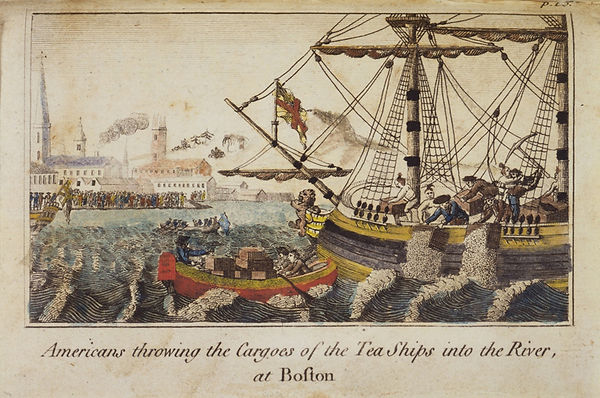
The Boston Tea Party (1773): To protest the Tea Act, the Sons of Liberty, dressed as Native Americans, dumped 342 chests of tea into the harbor, a direct challenge to British authority. This is probably the best-known among many pre-war protests and it triggered martial law plus a number laws collectively called “The Intolerable Acts”.
Figure 2: The Boston Tea Party
https://commons.wikimedia.org/wiki/File:Boston_Tea_Party-Cooper.jpg
-
Lexington and Concord (1775). Late on the night of April 18, 1775, British General Thomas Gage sent troops marching toward the towns of Lexington and Concord to seize rebel munitions and arrest leaders. Warned by a network of spies, by Paul Revere and two others on their midnight rides, plus by "Minutemen," the colonial militia was ready.
-
April 19, 1775: Shots were fired at Lexington, leaving eight Americans dead—the “Shot Heard ‘Round the World”.
-
At Concord, organized resistance forced a disorganized British retreat. Using guerrilla tactics, colonists—the Minutemen—inflicted over 250 casualties, while suffering only 90.
-
Southern colonies’ growing anger was fueled when Virginia’s Royal Governor Lord Dunmore issued a November, 1775 proclamation [Dunmore’s Proclamation] declaring martial law and offering freedom to indentured servants and enslaved people owned by Patriots if they left their masters and fought for the British. Plantation owners were furious which drew them closer to their brethren in New England.
-
Peremptory refusals to negotiate with the colonists, refusal by the Crown to recognize the de facto independence of the colonies for more than a hundred years, and unpopular laws and taxes got the people enraged. Not all of them, but enough to mount a revolution. The "war of words" had ended; the Revolutionary War had begun.
Revolutionary War Records. Piecing together the service records for any Revolutionary War serviceman can be a significant challenge. There are a large variety of local, state and national soldiers’ and sailors’ written records and on-line databases, none of which compile 100% of the names of those who served. Many list the same person under several names spelled differently.
-
Forbes, Forbs, Fobes, Fobs, etc., etc. As we know, the spelling of the Forbes name has a variety of iterations. That’s also true in those war records. For example, Absalom (spelled Absolom in a few records) is listed multiple times in separate records under Fobes, Forbes and Forbs as though it’s not the same person. And, distinguishing one Edward Fobes from another with the same or similar name can be tricky without a careful reading of what’s published and comparing what’s in the records.
Absalom’s Military Service (1775 and 1778). As a “Minuteman” [ready at a minute’s notice], Absalom “marched on the alarm” from Upton to Concord and Roxbury on April 19, 1775—the day the "shot heard 'round the world" was fired at Lexington and Concord.
-
1775. He served as a private for 8 days and then formally enlisted April 27 for a term which lasted 3 months and 12 days. In figures 3-6 below are copies of his “Minuteman” record, his and Edward’s name on a list of those who enlisted April 27, along with an enlargement showing their names listed as “Fobes”, Absalom’s preference.
Figure 3: Minuteman Record
https://www.familysearch.org/ark:/61903/3:1:3Q9M-CSQZ-C89P-K?view=index&cc=2548057&lang=en&groupId=
Figure 4: April 27, 1775 Enlistment Record
https://www.familysearch.org/ark:/61903/3:1:3Q9M-CSQZ-C842-L?view=index&cc=2548057&lang=en&groupId=
Figures 5: April 27, 1775 Enlistment Record
Figure 6: Enlargement of April 27, 1775 Enlistment Record
-
1775-78—a Blacksmith and Farmer. Between August, 1775 and June, 1778 Absalom was not in the army and what he did during that time is not documented. However, there’s a clue in a March, 1774 probate document from his father’s estate where he’s identified as “Absalom Fobes Blacksmith”. This skill would make him invaluable to the war effort. And, in a November, 1778 inventory of his own estate, he’s also described as a farmer raising oxen, cows, sheep, horses, “swine”, hay and “grain”.
-
1776 The Battle of White Plains. In 1776, two years before Absalom’s re-enlistment, the Battle of White Plains ended in defeat for General Washington and his army as they retreated from New York City following a series of British victories earlier that summer. Washington attempted to make a stand on a stretch of high ground to allow for the orderly consolidation and evacuation of personnel and much needed supplies. It was strategically important as a high ground position.
-
After his defeat, Washington was forced to retreat from New York into New Jersey. The campaign was rough for Washington’s soldiers, and after the string of losses, it seemed as if the Revolution was all but finished. However, since Washington and what remained of the patriot army escaped, the war was not over.
-
1778 Re-Enlistment. In June, 1778, he and his brother Edward re-enlisted for a nine-month term. One page of the of the roster showing the two—now listed as “Forbs”—is below in figure 7 and in figures 8-9 are military record cards, one for “Absolom” and the other for “Absalom”. This company of men mustered in Fishkill, NY June 19, and later moved to White Plains, where George Washington was encamped, about 21 miles north of Manhattan. He is described as being 5 feet, 9 inches tall and of “light” complexion.
Figure 7: June, 1778 Re-Enlistment Record for Absalom and Edward
Figure 8: June, 1778 Re-Enlistment Record
https:/www.familysearch.org/ark:/61903/3:1:3QHK-Q3P2- KQMS?view=fullText&keywords=Absolom%20Forbs&lang=en&groupId=
Figure 9: June, 1778 Re-Enlistment Record
https://www.familysearch.org/ark:/61903/3:1:3Q9M-CSQZ-C89C-F?view=index&cc=2548057&lang=en&groupId=
-
1778 White Plains Campground. During July-September, 1778, White Plains served as a major encampment for Washington’s Continental Army, which moved there to cooperate with the French navy and plan an attack on British-held New York City. Being there also served as a strategic barrier preventing the British from moving north from New York City. Washington held a Council of War at his headquarters on July 25, and moved his troops north from there on September 16.
-
1778 an “Artificer”. We know Absalom was with the troops at White Plains on July 7, and what he was doing. A record of military stores delivered that day (figures 10-12) shows him receiving 3 metal files as an “Artificer” and his name as “Forbes”.
-
As used in the 17th and 18th centuries, “Artificer” was a British and Colonial military term for a “skilled craftsman”—blacksmiths, wheelwrights, carpenters, armorers, mechanics. They maintained the army’s vital equipment from muskets to wagonwheels and became part of the army when it could no longer count on finding civilian specialized workers to hire. Without blacksmiths and other Artificers, the Continental Army’s wagons and weapons would have literally fallen apart.
Figure 10: Cover Page of the Receipt Book
Figure 11: Page #178 showing items received July 7,1778 at White Plains
Figure 12: Enlargement of List of Artificers from July 7, 1778 record above
-
1778 Absalom’s Death. Sometime in early September, 1778, Absalom died. The exact date is unknown. He was just 27. Depending on the source, he succumbed to a combination of "camp fever" or "exposure" plus his "wounds." While history records no major battle at White Plains during those weeks, the life of a soldier was defined by constant, perilous skirmishes and the grueling conditions of life in the field.
-
Genealogist Myra Adams Chiles offers a more specific, though undocumented, account of his final days. She suggests, in on-line notes about her self-published 2017 compilation Descendants of John Fobes and Constant Mitchell [http://henryadamsofbraintree.com/fobesforbes-in-america.html.],
that in early September Absalom was part of a five-man scouting party sent to reconnoiter enemy positions outside the main encampment. According to the sole survivor, .
“After researching the whereabouts of Capt. Darrow's Company for September 1778, it seems that in early September 1778 a team of 5 men were sent to check an area outside of White Plains where the enemy might have been. According to the one man who survived, they were ambushed. Therefore, I believe this is when/where Absalom was killed.”
-
The location and date of Absalom’s burial is unknown. It seems likely he was buried in an unmarked grave near the fields of White Plains.
Absalom’s Estate: Absalom died intestate—without a will. His probate estate, under the name “Fobes”, opened October 1, 1778 with his widow Martha and her father Willis Hall appointed as administrators. [A complete record of estate documents is found at: https://www.familysearch.org/ark:/61903/3:1:3QS7-L9V1-2NS9?view=fullText&keywords=Absalom%20Fobes&lang=en&groupId=.]
-
As was typical in such circumstances, Martha remarried two years later to help provide for her four young boys, including Absalom, Jr. who was born Novermber 1, 1778, about two months after his father’s death.
-
Though Absalom had been a skilled blacksmith and a diligent farmer, his service to his country left his estate unable to cover its obligations. By December 1784, the estate was "greatly in debt" which forced the administrators to petition the Worchester County Court to grant them permission to sell the farm to satisfy creditors. The court agreed.
-
It took more than two decades to unwind Absalom’s estate. In November, 1799—twenty-one years after his death—the estate finally closed with a last distribution of $41 (figure 13) to the heir then reaching his majority who never knew his father: Absalom Forbes, Jr.
Figure 13: November, 1799 final distribution receipt
Epilogue
-
Of Absalom’s five children, all boys, we know nothing about Levi, the third child, born in 1774. It’s presumed he died at a very young age. We do know more about the others, however—Abner, Libeus, Jotham and Absalom, Jr. Each married (Libeus and Absalom, Jr. more than once), had children, and was successful in his own way. The oldest son, Abner, is my third great-grandfather.
-
Absalom’s role in the war was a minor one. No books were written about him nor movies made. He gets some notarity for being a Minuteman and being at Concord, but we don’t know if he shot at any Redcoats. There’s no record he saw any “action” during his April 27, 1775 enlistment. He probably served as a blacksmith.
-
Later, during his 1778 re-enlistment, he provided a valuable, but unsung service, as a blacksmith Artificer doing the unglamerous, but absolutely vital work needed to keep the army on the move and its weapons and equipment in shape. How much “action” he saw is unknown except for the one time in September, 1778 when he suffered his fatal wounds.
-
Many of my ancestors—direct and indirect—served in the Revolution and most survived, including Absalom’s brothers Edward and Jotham. One indirect ancestor, a fifth great grand-uncle (not a Forbes), died on board a prisoner of war ship in New York Harbor, but Absalom is ths only direct ancestor I’ve found who was killed in action.
-
The records don’t tell us what he thought or what he feared, only that he served and how he served. Whatever his role, Absalom answered the call. I’m proud he did so and I’m proud to call him my ancestor.
April, 2026
Paul Moore
Gainesville, FL