
Absalom Fobes: Blacksmith and Farmer in the American Revolutionary War
Updated: May 25
By Paul Moore, Gainesville, Florida

This year, the United States marks the 250th anniversary of the signing of the Declaration of Independence from Great Britain. For some, this was a revolutionary break. For others, this was a gradual separation due to Britain's century of "salutary neglect," according to Edmund Burke in his “Speech on Conciliation with America” in the House of Commons on March 22, 1775.
Many colonists were caught up in this break, including my 4th great-grandfather, Absalom Fobes (1751—1778) from Upton, Worcester County, in the Massachusetts Bay Colony.

Absalom himself was the great-great-grandson of immigrant John Fobes who first arrived in Plymouth Colony and later settled in Bridgewater. Absalom’s parents Abner and Phebe Leach Fobes had eight children born between 1749 and 1763. Two of the girls died at a young age while three married and had children. The deaths of two of these girls were not recorded, whereas the third died in 1825. All three boys—Absalom, Edward and Jotham— became adults, married, had children and served in the American Revolutionary War. Edward and Jotham lived many years, but Absalom died at age 27 in 1778, a casualty of war.
Phebe Leach was descended from colonists aboard the Mayflower from two family lines. The first is James Chilton and his wife, whose name is unknown. Chilton’s wife died onboard the Mayflower while it was anchored in Provincetown Harbor, before the move to Plymouth. Chilton died n December 1620, a few weeks after signing the Mayflower Compact. This was an agreement in which the settlers pledged to form a self‑governing community based on majority rule when they landed at Plymouth in 1620. His daughter Mary is thought to be the first woman to step onto Plymouth Rock.
The second family line is through Francis Cooke, who traveled on the Mayflower with his son, John. His wife Hester and their other children, including daughter Jane, followed in 1623. He was also a signer of the Mayflower Compact. Chilton’s great-granddaughter Hannah Latham married Francis Cooke’s great-grandson Joseph Washburn, connecting the two lines.
Absalom Fobes married Martha Hall in 1771, and they settled in Upton, Worcester County, in the Massachusetts Bay Colony. They had five boys named Abner, Libeus, Levi, Jotham, and Absalom, Jr. Abner and Jotham lived into their 50s while Libeus and Absalom, Jr., lived into their 70s. Levi’s death is not recorded. After Absalom’s 1778 death, Martha remarried in 1780 and had eight more children. She died in 1828 at age 76.
Absalom and Phebe Fobes lived in tumultuous times. In 1754, a young George Washington sparked the French and Indian War, a conflict between British and French forces over control of the Ohio River Valley, by leading colonial militia in battle against French soldiers at Fort Necessity in Pennsylvania. This simmered until 1756 when Prussia invaded Saxony, involving Austria, France, Russia, Great Britain and others in what was to become the Seven Years War. Believing the colonies should pay for their defense and cover war debts after Britain's victory, the British Parliament enacted a series of new taxes and tariffs. It also forbade settlement west of the Appalachian Mountains and required colonists to house and feed British soldiers.
Protests erupted among the American colonists that resulted in the Boston Massacre of 1770, the Boston Tea Party of 1773, and armed conflicts at Lexington and Concord in 1775. The British Crown refused to negotiate with the colonists, dismissed more than a century of their de facto independence, and imposed unpopular laws and taxes that enraged the people. Not everyone rose up, but enough did to launch a revolution. The war of words ended; the Revolutionary War began. Absalom Fobes joined the fight.
Piecing together the service records for any Revolutionary War serviceman can be a significant challenge. There is a large variety of local, state and national soldiers’ and sailors’ written records and on-line databases, none of which compile 100% of the names of those who served. Many list the same person under several names spelled differently.
As members of Clan Forbes know, the spelling of the Forbes name has a variety of iterations. That’s also true in those war records. For example, Absalom (spelled Absolom in a few records) is listed multiple times in separate records under Fobes, Forbes and Forbs as though it’s not the same person. And, distinguishing one Edward Fobes from another with the same or similar name can be tricky without careful reading of what’s published and comparing what’s in the records.
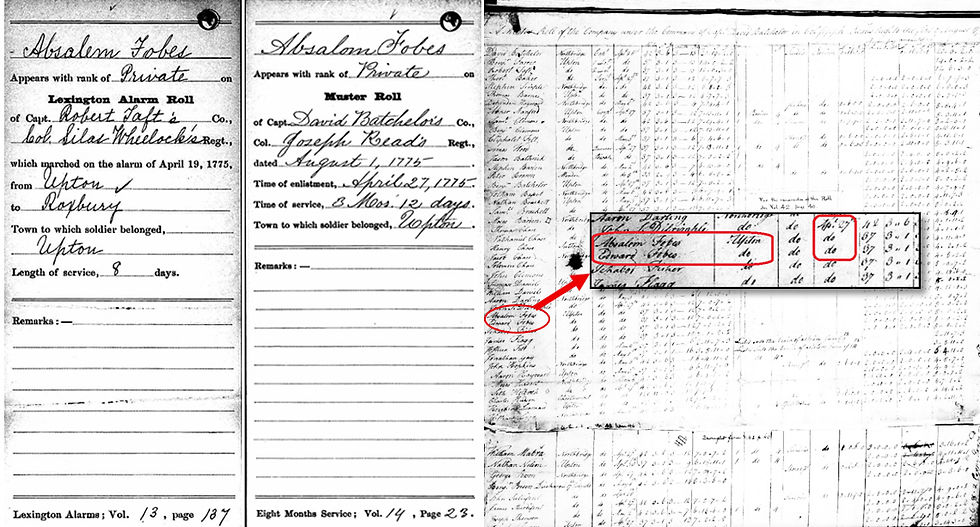
As a “Minuteman,” Absalom was “ready at a minute’s notice.” He marched from Upton to Concord and Roxbury on April 19, 1775—the day the "shot heard 'round the world" was fired at Lexington and Concord. This term was how Ralph Waldo Emerson described the colonial resistance in his 1837 poem “Concord Hymn.” Absalom served as a private for eight days until he formally enlisted on April 27, for a term of three months and twelve days.
Between August 1775 and June 1778, Absalom was not in the army, and his activities are not documented. However, a March 1774 probate document from his father’s estate identifies him as “Absalom Fobes Blacksmith.” This skill would make him invaluable to the war effort. An inventory of his own estate dated November 1778 describes him as a farmer raising oxen, cows, sheep, horses, swine, hay, and grain.
In June 1778, Absalom Fobes and his brother Edward re-enlisted for a nine-month term. This time, both surnames appeared as “Forbs” and one military record card spelled his first name “Absolom” and the another for “Absalom.” He is described as being 5 feet, 9 inches tall and of “light” complexion.

They joined a company of men mustered at Fishkill, NY June 19. They moved to White Plains, where George Washington was encamped, about 21 miles north of Manhattan. From July to September, 1778, White Plains served as a major encampment for Washington’s Continental Army. From there, the army coordinated with the French navy to plan an attack on British-held New York City. The location served as a strategic barrier to prevent the British from moving north from New York City.

A record of military stores delivered on July 7, 1778, shows Absalom receiving three metal files. His surname is listed as “Forbes” and he is identified as an “Artificer.” As used in the seventeenth and eighteenth centuries, this was a British military term for a “skilled craftsman,” such as blacksmiths, wheelwrights, carpenters, armorers, and mechanics. They maintained the army’s vital equipment from muskets to wagon wheels and became part of the army when it could no longer count on finding civilian specialized workers to hire.
Sometime in early September, 1778, Absalom died at the age of twenty-seven. Various sources describe his cause of death as a combination of "camp fever" or "exposure" plus his "wounds." While history records no major battle at White Plains during those weeks, the life of a soldier was defined by constant, perilous skirmishes and the grueling conditions of life in the field.
However, genealogist Myra Adams Chiles suggested that “after researching the whereabouts of Capt. Darrow's Company for September 1778, it seems that in early September 1778 a team of 5 men were sent to check an area outside of White Plains where the enemy might have been. According to the one man who survived, they were ambushed. Therefore, I believe this is when/where Absalom was killed.” (Chiles, Myra Adams. 2017. Descendants of John Fobes and Constant Mitchell. West Chester, Pennsylania.)
The location and date of Absalom’s burial is unknown. It seems likely he was buried in an unmarked grave near the fields of White Plains. Absalom died intestate, without a will. His probate estate, under the name “Fobes,” opened October 1, 1778 with his widow Martha and her father Willis Hall appointed as administrators. Martha remarried two years later to help provide for her four young boys, including Absalom, Jr. who was born Novermber 1, 1778, about two months after his father’s death.

Although Absalom had been a skilled blacksmith and a diligent farmer, his service to his country left his estate unable to cover its obligations. By December 1784, the estate was greatly in debt which forced the administrators to petition the Worchester County Court to grant them permission to sell the farm to satisfy creditors. The court agreed. Absalom’s estate was finalized after two decades. In November, 1799, the estate closed with a distribution of $41 to Absalom Forbes, Jr., when he reached his majority.
Absalom had five children, all boys. Levi, the third child born in 1774, likely died at a very young age. Each of the other sons, Abner, Libeus, Jotham and Absalom, Jr., married, had children, and was successful in his own way. The oldest son, Abner, is my third great-grandfather.
Absalom’s role in the war was a minor one. No books were written about him nor movies made. He gets some notarity for being a Minuteman and being at Concord, but we don’t know if he shot at any Redcoats. There’s no record he saw any “action” during his April 27, 1775 enlistment. He probably served as a blacksmith.
Later, during his 1778 re-enlistment, he provided a valuable but unsung service as a blacksmith Artificer doing the unglamorous but absolutely vital work needed to keep the army on the move and its weapons and equipment in shape. How much “action” he saw is unknown except for the one time in September, 1778 when he suffered his fatal wounds.
Many of my ancestors served in the Revolution and most survived, including Absalom’s brothers Edward and Jotham. One ancestor, a fifth great grand-uncle (who was not a Forbes), died on board a prisoner of war ship in New York Harbor, but Absalom is the only direct ancestor I’ve found who was killed in action.
The records don’t tell us what he thought or what he feared, only that he served and how he served. Whatever his role, Absalom answered the call. I’m proud he did so and I’m proud to call him my ancestor.


Comments