
Edinglassie House
Updated: Jun 20
By B. R. Forbes, Clan Historian & Storyteller

Edinglassie House stands in the quiet upper reaches of Glen Ernan, a side valley of Strathdon long associated with the Forbeses of Newe. Its personality is unmistakably shaped by the family who built, expanded, and stewarded it: practical Highland lairds who became global merchants, political figures, and symbols of Forbes resilience. Edinglassie is the Highland laird poet, a blend of rugged landscape and refined sensibility. Edinglassie is the Forbes who writes letters by the fire, who walks the hills at dusk, who hosts guests with gentle courtesy. She is dignified, reflective, and slightly solitary—comfortable in both drawing rooms and deer forests.
The first appearance of Edinglassie in the historical record comes in a 1490 charter tied to the Gordon sphere of influence in Strathdon. At that time, the lands were firmly associated with the Gordons of Glenbuchat and their cadet branches, already functioning as a distinct territorial unit by the end of the 15th century. Through the 1500s, Edinglassie appears repeatedly in Gordon charters, Huntly confirmations, and descriptions of Strathdon and Glen Nochty, underscoring its place within a well‑established Gordon landscape.
For the Forbes family, the eventual acquisition of Edinglassie marked far more than the addition of another Strathdon property—it signaled the quiet but decisive shift of regional authority from Gordon to Forbes hands. As Gordon fortunes faltered in the mid‑17th century under the pressures of war, debt, and political upheaval, the Forbeses advanced through a combination of strategic marriages and timely land consolidation.
One key link was the marriage of Henry Forbes, fourth laird of Boyndlie, to a daughter of the Gordon of Edinglassie, creating an early hereditary foothold. That foothold strengthened when the rising Forbes of Newe and their Skellater cadet branch began acquiring estates across upper Donside. William Forbes, 2nd laird of Skellater, married Isobel, daughter of Alexander Forbes of Newe, and their second son—born in 1668—was styled William of Edinglassie, clear evidence that the estate had passed fully into Forbes possession by that time.
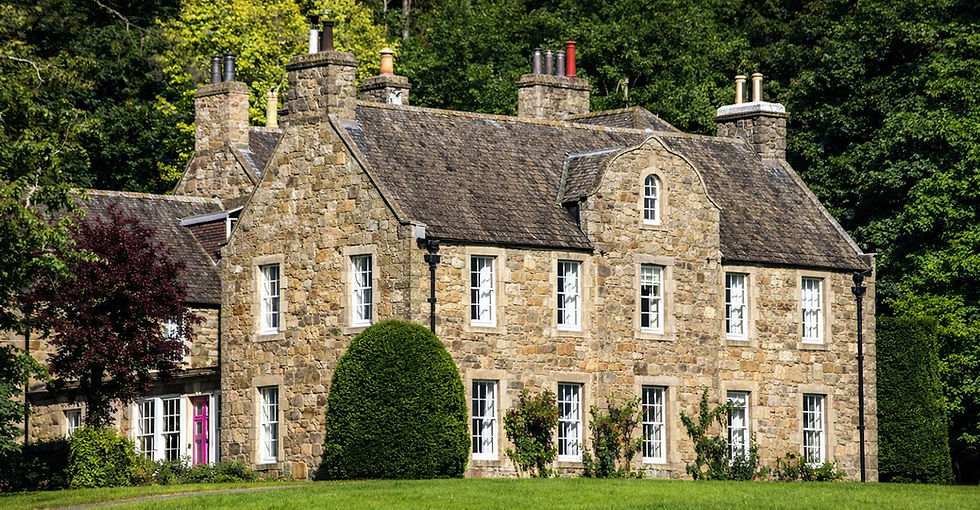
The earliest portion of Edinglassie House rose in the early 1700s, almost certainly under William Forbes, 5th Laird of Newe (d. 1784). William controlled the estate during a period of renewed Forbes consolidation in Strathdon. He created the original two‑story, attic‑topped house built on a U‑shaped plan with five bays.
The late‑18th‑century eastward extension fits the ambitions of either William or his son, John Forbes, the Bombay merchant, who returned from India with considerable wealth. This father‑and‑son period saw vigorous reinvestment across the Newe and Edinglassie properties. The addition of a lower three‑bay wing with its distinctive crenellated canted window reflects the kind of confident, incremental improvement typical of the Forbes estate strategy in the 1770s to 1790s.
The early‑19th‑century remodeling included refined joinery, molded cornices, improved plasterwork, and reorganized circulation. This was likely under the direction of Sir Charles Forbes of Newe and Edinglassie (1774–1849).
Around 1850, the estate entered its Victorian phase. The broad gabled bay on the east and the full‑height canted bay on the west align perfectly with the tenure of James Forbes, 17th Laird of Newe (1803–1868). James inherited shortly after Sir Charles’s death and embraced the mid‑Victorian appetite for picturesque asymmetry and expanded domestic comfort. These additions reflect his era’s architectural preferences and his responsibility for maintaining and updating the family’s Strathdon residences.
Edinglassie House remains a private residence and is still used as a hunting lodge, consistent with its long history as part of a Highland sporting estate. Its Category C listing ensures preservation oversight, but the house is not open to the public. Modern ownership is not publicly listed, as is typical for private Scottish estates.
Edinglassie House is one of the most evocative surviving expressions of Forbes heritage in Strathdon. Built in the early 18th century, expanded through the Georgian and Victorian eras, and shaped by generations of the Forbes of Newe, it embodies the clan’s resilience, ambition, and deep connection to the Highland landscape. Though privately held today, its granite walls and layered architecture continue to tell the story of a family whose influence radiated from these quiet upland valleys to India, Parliament, and beyond.


Comments