
Alford and the House of Forbes
By B. R. Forbes, Clan Historian & Storyteller

The village of Alford lies within the Howe—or Vale—of Alford, a fertile basin formed by the River Don in central Aberdeenshire. Sheltered by surrounding hills and connected historically by ancient routeways linking Highland and Lowland Scotland, the district has long been one of northeastern Scotland’s most productive agricultural regions. Yet Alford’s historical identity cannot be understood apart from the rise and endurance of one family: the House of Forbes.
From the fourteenth century onward, the Forbes dynasty shaped the political authority, agricultural development, and cultural character of the valley, becoming one of the few Celtic-origin noble families to maintain continuous territorial influence into the modern era. (Tayler, Alistair and Henrietta. 1937. House of Forbes. Edinburgh: Third Spalding Club.) Across more than six centuries, village and lordship evolved together, creating one of Scotland’s clearest examples of a living clan landscape.
Archaeological and landscape evidence indicates long habitation in the Vale of Alford before written records, with early agricultural activity suggesting sustained settlement patterns tied to fertile riverine soils. (Bisset, Alastair. 1984. A Short History of Alford and District. Alford: Alford & District Heritage Society.)
By the medieval period, the area functioned primarily as a rural parish centered on farming communities and ecclesiastical lands along the River Don. (Simpson, William Douglas. 1941. The Province of Mar. Aberdeen: University Press.) These early settlements formed the foundation upon which later feudal lordship—and ultimately Forbes authority—would develop.
During the early fourteenth century, the Forbes family emerged as one of the dominant landholding dynasties of central Aberdeenshire. Their consolidation of estates along the River Don coincided with the decline of older Gaelic provincial structures associated with the mormaerships of Mar and Buchan.(Grant, Alexander, and Stringer, Keith, editors. 1993. Medieval Scotland: Crown, Lordship and Community. Edinburgh: Edinburgh University Press.) Under figures such as Sir John Forbes “of the Black Lip” (c. 1347 – 1406) and his descendants, the family expanded its territorial influence across Donside. Alford at this time existed as a kirktown and agricultural district composed of scattered farms, mills, and tenant holdings increasingly drawn into a Forbes-controlled sphere. (Bisset, Alastair. 1984. A Short History of Alford and District. Alford: Alford & District Heritage Society.)
Rather than functioning as an independent burgh, the settlement developed within a clan-based socio-economic system in which tenancy, agriculture, and local governance were shaped by lordship authority.
A decisive turning point came after the Battle of Harlaw in 1411, fought only a short distance east of Alford. Sir John Forbes’s eldest son, Sir Alexander Forbes (c. 1380 – 1449) supported the Earl of Mar and strengthened the family’s political standing and secured royal favor. (Barrow, G. W. S. 2003. The Kingdom of the Scots. Edinburgh: Edinburgh University Press.) By the mid-fifteenth century, Sir Alexander was created the 1st Lord Forbes, formalizing the family’s status among Scotland’s regional magnates. The earlier residence at Putachie—predecessor to Castle Forbes—became the administrative center of this expanding estate.
From this period onward, Alford’s development became inseparable from Forbes authority, functioning within a hereditary territorial lordship whose economic and social rhythms were defined by estate governance.
The later medieval period was marked by intense regional rivalries, most notably between the Forbeses and the Gordons. Positioned between competing spheres of influence, the Alford district occasionally experienced instability generated by these conflicts. Despite turbulence, Forbes estate management encouraged agricultural expansion and settlement stability. Estate oversight promoted organized tenancy and ecclesiastical patronage linking parish life closely to clan leadership. By 1600, Alford had grown into a recognizable rural community whose prosperity was closely tied to the fortunes of the Forbes estates. (Bisset, Alastair. 1984. A Short History of Alford and District. Alford: Alford & District Heritage Society.)

The seventeenth century brought religious and political upheaval during the Wars of the Three Kingdoms. The Forbes family aligned strongly with the Covenanting cause, drawing many tenants and local men into national conflict. The most dramatic episode occurred on 2 July 1645 at the Battle of Alford, when Royalist forces under James Graham, Marquis of Montrose, defeated a Covenanter army near the village. Many soldiers fighting for the Covenanters were drawn from Forbes territories, and the aftermath brought reprisals, agricultural disruption, and economic strain throughout the district. (Terry, Charles Sanford. 1899. The Life and Campaigns of Alexander Leslie. London: Longmans, Green, and Co.) The battle permanently embedded Alford within Scotland’s national historical narrative.
Following seventeenth-century instability, the eighteenth century ushered in an era of agricultural improvement across Scotland. The Lords Forbes actively participated in estate modernization, transforming both landscape and society. Key developments included drainage and reorganization of farmland, improved crops and livestock, road construction, and long-term tenant leases promoting rural stability. (Whyte, Ian. 1979. Agriculture and Society in Seventeenth-century Scotland. Edinburgh: J. Donald.) Unlike some Highland estates, Castle Forbes did not pursue widespread clearances, instead emphasizing continuity and productivity.

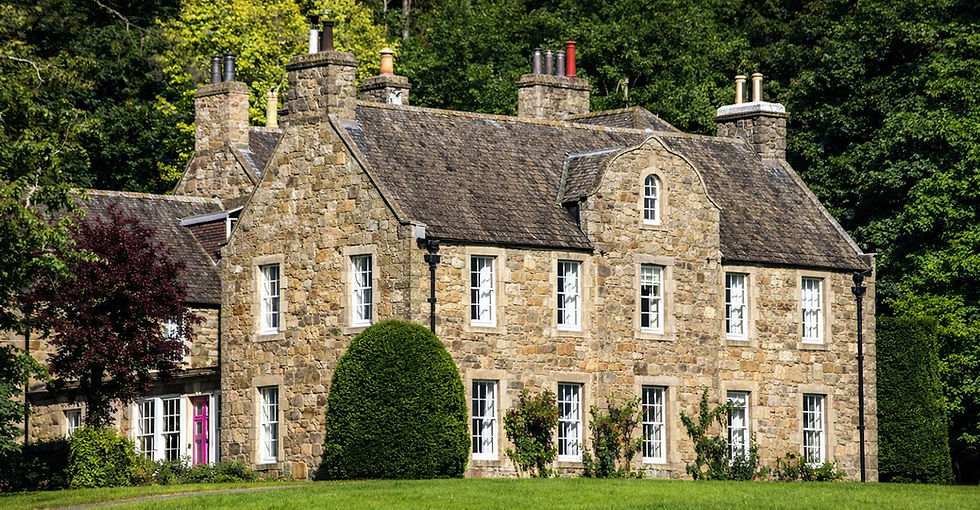
The construction of the present Castle Forbes in 1815 symbolized renewed confidence and permanence. Built by James Ochoncar, 17th Lord Forbes (1765 – 1843), the castle reinforced Alford’s identity as the heart of Forbes country and provided employment and patronage for the surrounding community.
Rail transport arrived in Alford in 1859, marking a major turning point in the economic and social development of the Howe of Alford. The Alford Valley Railway, constructed as a branch line from Kintore, linked the rural district directly to Aberdeen and the wider Scottish rail network. The line opened to traffic in March 1859, and Alford railway station was constructed and inaugurated as the terminus of the line at that time.
The railway significantly improved access to markets for agricultural produce and granite from local quarries, integrating Alford more fully into regional commerce during the Victorian period.
Estate influence remained central to daily life: many residents worked on Forbes lands or estate-supported trades, while members of the Forbes family served as civic leaders and patrons of religious and educational institutions. During both World Wars, men from Alford and the Forbes family served prominently, with local memorials reflecting shared sacrifice between estate and community.

Postwar economic change transformed Alford from an agricultural service center into a heritage-focused rural community. Industrialization largely bypassed the district, allowing historical continuity rarely preserved elsewhere in Scotland.
Modern institutions now interpret this legacy, including the Alford Heritage Museum and the Grampian Transport Museum, which preserve the region’s agricultural and technological history.
Since the fourteenth century, Alford has evolved not merely as a rural Aberdeenshire village but as the geographic and cultural expression of the House of Forbes. Today, Alford stands as a rare example in Scottish history where village and noble house remain historically, geographically, and culturally intertwined.
To understand Alford is therefore to understand the House of Forbes itself—a continuity of place and people extending across more than six hundred years.


Comments